

What You Believe About Your Health Is Shaping the Outcome
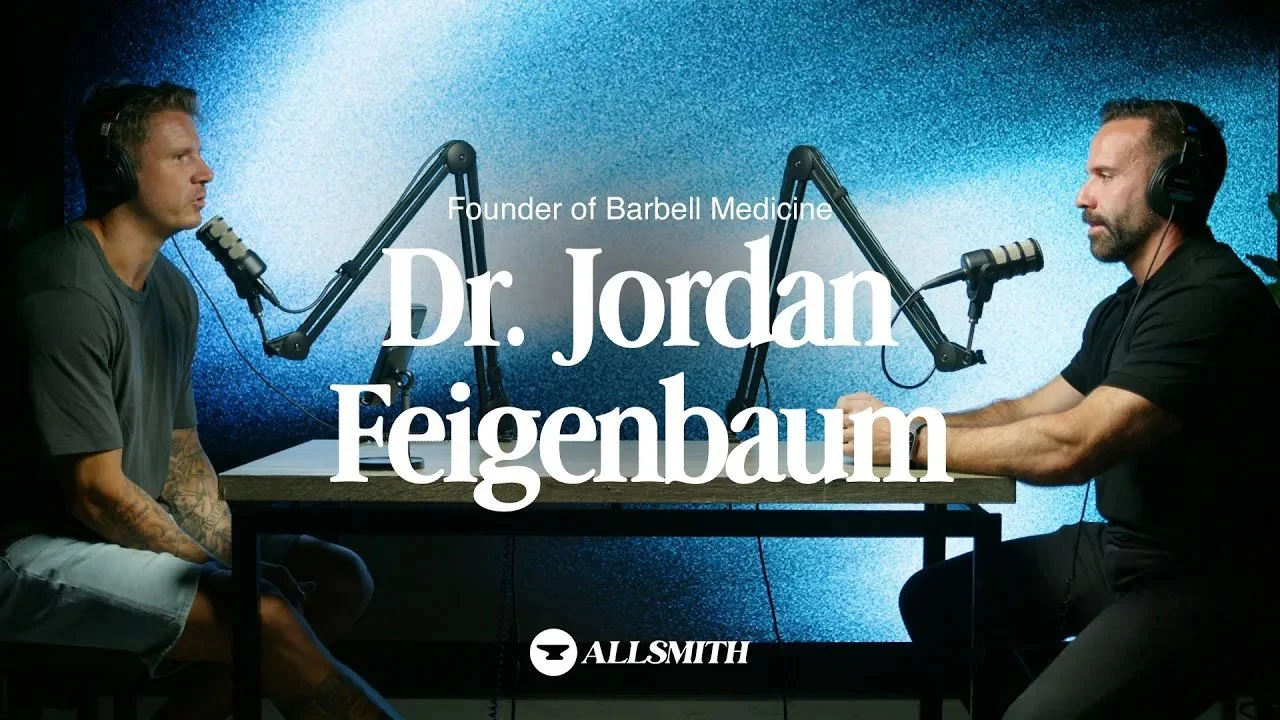
What physician, competitive powerlifter, and founder of Barbell Medicine Dr. Jordan Feigenbaum understands about the science of belief, the myth of bro science, and why your mindset may be the most underrated variable in health.
Half of a group of patients with meniscus injuries received real surgery. The other half were put under general anesthesia, had the incisions made, and the joint flushed — but no actual procedure was performed. When researchers checked outcomes two years later, both groups had improved at nearly identical rates.
Dr. Jordan Feigenbaum didn't share that story to argue against surgery. He shared it to make a harder point.
Your expectation of benefit from an intervention can drive the outcome more than the intervention itself.
“People with high self-efficacy — the belief that they can play an active role in their own trajectory — have shorter disability, less pain, and better outcomes. That’s not woo. That’s the research.”
Medicine spent decades operating on a purely biological model — find the structural problem, fix the structure. What the research now shows is that biology is only part of the picture. The biopsychosocial model accounts for what the biomedical model couldn't explain: why two people with identical MRIs can have completely different levels of pain and disability.
The person who believes they have the tools, the resources, and the agency to affect their own outcome — they do better. Not by accident. The belief changes the behavior, and the behavior changes the biology.
The average person with obesity will try to lose weight eight times in their lifetime. By attempt nine, they have demonstrable proof it probably won't work. That psychological weight is real — and often heavier than the physical one.
The Lesson
The science doesn't say mindset cures everything. It says that what you believe about your ability to affect your own outcome is a measurable variable — one that consistently predicts how well you'll respond to treatment, training, and change.
Which means the work isn't just physical. If you walk into the gym believing it won't work, that belief is already doing something. And if you walk in believing you have agency — that your effort, your consistency, and your choices actually matter — that's doing something too.
Ownership and responsibility aren't just character traits. According to the research, they are clinical predictors of better health outcomes.
Most experts with a lot of experience will agree on 75 to 80 percent of any given topic. It's the edges where it falls apart. Start with the 80 percent — the things everyone agrees on — and build from there.
This conversation covers obesity, GLP-1s and what the evidence actually says, the peptide industry, sham surgery studies, pain science, testosterone, longevity, wearables, the carnivore diet, and how to find real expertise in a landscape designed to confuse you.
Dr. Feigenbaum doesn't give easy answers. He gives better questions. And by the end of this episode, you'll have both.
This Week's Question